
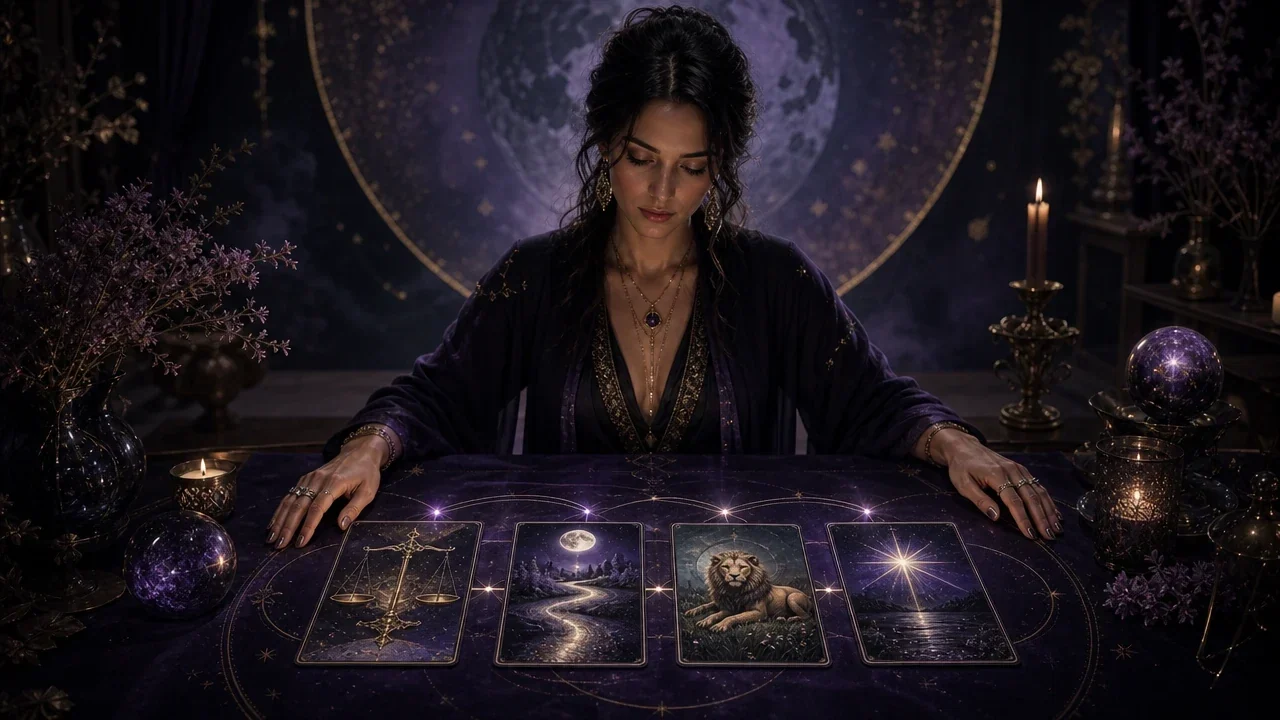
When you first begin reading Tarot cards, the natural instinct is to look up each card individually, collect separate meanings, and then try to assemble them into a coherent answer. This approach provides a starting point, but it leaves much of the reading's depth untouched. A card drawn in isolation carries symbolic possibilities. A card drawn beside others becomes part of a conversation.
The interpretive power of Tarot emerges not from memorizing fixed definitions, but from recognizing how cards influence one another within a spread. The same card can suggest patience in one reading and avoidance in another, depending on what surrounds it, where it appears, and what question the reader brings. Understanding Tarot card combinations means learning to read the relationships between cards as carefully as you read the cards themselves.
This shift from isolated meanings to connected interpretation is neither complicated nor mysterious. It requires attention to three layers: the card's core symbolic range, the position it occupies, and its relationship to the cards around it. Together, these layers form one narrative that can support thoughtful reflection far more effectively than a list of separate card definitions ever could.
Why Isolated Card Meanings Are Not Enough
Each Tarot card carries a range of symbolic associations. The Hermit may suggest solitude, introspection, patience, or the search for clarity. The Chariot may indicate determination, movement, control, or the tension between opposing forces. These possibilities remain abstract until they meet a specific question and a specific arrangement of other cards.
When you read cards one at a time without considering their context, you collect fragments rather than forming a complete picture. A reading that tells you The Hermit suggests reflection and The Chariot suggests action leaves you with two separate ideas that may seem contradictory or unrelated. The question of how they fit together, what their sequence suggests, and which aspect of each card becomes relevant remains unanswered.
Reading Tarot cards together requires recognizing that meaning emerges from relationship. The Hermit beside The Chariot may suggest a tension between needed pause and felt urgency. The Hermit followed by The Chariot may suggest that a period of solitary thought is leading toward decisive movement. The order matters. The surrounding cards matter. The question and the reader's circumstances matter. The card's symbolic range provides material, but the combination gives it direction.
The Three Layers of a Tarot Combination
Every card in a spread exists within three overlapping layers of meaning. The first layer is the card's inherent symbolic vocabulary: the images, archetypes, emotional tones, and thematic associations that have developed through Tarot's history and use. This layer provides the foundation.
The second layer is positional. A card drawn to represent the current situation carries different weight than the same card drawn to represent potential or outcome. Position gives the card a role within the narrative structure of the spread. It tells you what aspect of the card's range to prioritize and what question the card is answering.
The third layer is relational. A card's meaning shifts depending on what precedes it, what follows it, and what appears alongside it in other positions. This is where tarot card relationships become interpretive rather than formulaic. The Lovers beside The Tower may introduce disruption, revelation, or instability around an important relationship, value, or choice. The Lovers beside The Star suggests renewal, hope, or alignment within connection. The same first card produces different coherent readings depending on its companion.
These three layers do not operate separately. They fold into one another to create a single, situated meaning. The interpretive skill lies in holding all three layers in view simultaneously and allowing them to inform one another rather than treating any single layer as the definitive answer.
Reinforcement, Contrast, and Development
Cards interact in several recognizable patterns. Understanding these patterns helps you move from seeing separate images to recognizing the relationships that give a spread its interpretive coherence.
Reinforcement occurs when two or more cards emphasize related themes. The Hermit and The High Priestess together strengthen the suggestion of inward attention, private understanding, and the value of patience. Neither card cancels the other. Instead, they create a concentrated focus that makes the theme harder to dismiss or overlook. When several cards reinforce one direction, the reading may draw particular attention to a quality or need that deserves closer consideration.
Contrast introduces tension between different impulses, perspectives, or emotional states. The Chariot and The Hanged Man present a vivid example. One card suggests determined forward movement and control. The other suggests suspension, surrender, and the wisdom of waiting. This is not contradiction. It is complexity. The contrast may reflect a genuine internal conflict, competing priorities, or the need to balance action with reflection. Apparently opposing cards should not be forced into artificial agreement. Their tension may be the most accurate part of the reading.
Development appears when the sequence of cards suggests movement from one condition toward another. The Tower followed by The Star creates a narrative arc: disruption, collapse, or necessary ending gives way to the possibility of renewal, clarity, and restored trust. The second card does not erase the first. It suggests what may follow if the disruption is allowed to complete its work. Development readings feel like stories because they honor sequence and change rather than presenting a static state.
How Position and Sequence Change the Reading
Position assigns meaning before the first card is even drawn. In TarotReveal's four-card structure, the positions are the current situation, how the situation is already formed, potential and possibilities, and the likely outcome or direction. Each position asks a different question of the card that occupies it.
Justice in the current situation suggests that fairness, accountability, or the need for clarity has become central. Justice in how the situation is already formed suggests that past decisions, consequences, or the demand for balance contributed to where things stand now. Justice in potential suggests that fairness and measured judgment offer constructive possibilities. Justice in the likely outcome suggests movement toward resolution, clarity, or the restoration of balance. The card remains symbolically consistent, but its interpretive emphasis changes with its role in the spread.
Sequence adds another dimension. A card early in the spread establishes context. A card late in the spread responds to that context or redirects it. The Moon in the first position and The Sun in the fourth position suggests movement from uncertainty toward clarity. The Sun in the first position and The Moon in the fourth suggests that current confidence may meet ambiguity or hidden complexity later. The same two cards produce different stories depending on their order.
This is why Tarot spread interpretation cannot be reduced to lookup tables or fixed formulas. The question, the positions, the sequence, and the surrounding cards all participate in shaping what any individual card may mean within that particular reading.
Reading a Four-Card Combination as One Story
A detailed example demonstrates how the layers and relationships come together. Consider a four-card reading using Major Arcana cards: Justice in the current situation, The Moon in how the situation is already formed, Strength in potential and possibilities, and The Star in the likely outcome or direction.
Begin with Justice in the present. The card suggests that fairness, accountability, honesty, or the need for clarity has become pressing. Something requires careful judgment or the restoration of balance. The situation feels weighted, consequential, or ethically significant.
The Moon in how the situation is already formed adds context. Uncertainty, incomplete information, intuition without confirmation, or emotional complexity contributed to the present need for Justice's clarity. Perhaps the foundation of the situation involved ambiguity, unspoken feelings, or perceptions that were not fully examined. The Moon does not make Justice wrong. It explains why Justice feels necessary now.
Strength in potential introduces the possibility of patient courage, measured response, and inner resilience. Rather than forcing resolution or demanding immediate answers, Strength suggests that gentle persistence and emotional steadiness offer constructive direction. The card does not promise easy solutions. It identifies a quality that may help navigate the tension between The Moon's uncertainty and Justice's demand for clarity.
The Star in the likely outcome suggests renewal, openness, and the gradual restoration of trust. It does not guarantee a specific result. It indicates a direction: if the situation can hold space for both honest clarity and patient strength, the path may lead toward healing, hope, and greater alignment. The Star does not erase The Moon's complexity or Justice's weight. It suggests what may follow if the earlier cards are honored rather than bypassed.
This is one plausible reading. Another reader might emphasize different aspects of the same cards. The interpretation remains open because Tarot works symbolically rather than prescriptively. What matters is that the four cards form a coherent narrative that reflects the question and resonates with the reader's lived experience.
A Practical Method for Reading Cards Together
Moving from theory to practice requires a repeatable process. The following steps provide structure without imposing rigidity:
- Identify the question and spread structure. Know what each position represents before you begin interpreting individual cards.
- Read each card in its assigned position. Notice what the card suggests when placed in that specific role within the spread.
- Notice recurring or contrasting themes. Do multiple cards emphasize the same quality? Do they introduce tension or complexity?
- Observe the sequence and direction of movement. Does the reading suggest progression, reversal, or circular return?
- Identify the strongest relationship between neighboring cards. Which pairs create the most vivid reinforcement, contrast, or development?
- Form one tentative narrative. Describe the complete spread as a single story rather than four separate observations.
- Compare that narrative with the complete spread and your lived context. Does the interpretation feel coherent and relevant? Does it reflect complexity you recognize?
- Keep the interpretation open to revision. A good reading organizes symbolic possibilities. It does not close inquiry.
This process works whether you are reading for yourself or considering how different Major Arcana combinations might function within TarotReveal's structure. The goal is synthesis: bringing separate elements into one thoughtful, reflective interpretation that honors both the cards and the question.
Holding the Interpretation Open
A coherent reading does not eliminate ambiguity. It organizes symbolic possibilities into a narrative that can support reflection, clarify patterns, and suggest direction without claiming certainty or removing personal agency.
Two readers may interpret the same combination differently and both produce useful readings. The Sun and The Moon together may suggest the interplay of clarity and mystery, conscious awareness and unconscious influence, confidence alongside doubt. Depending on the question, the positions, and the surrounding cards, one reader may emphasize integration while another highlights unresolved tension. Neither interpretation is objectively wrong if both honor the cards' symbolic range and the reader's circumstances.
This openness is not weakness. It reflects the nature of symbolic interpretation. Tarot cards do not carry hidden messages that exist independent of context. They provide a structured vocabulary for examining experience, exploring choices, and recognizing emotional or situational patterns. Reading Tarot in context means treating the cards as reflective tools rather than as sources of supernatural authority or guaranteed predictions.
The relationships between cards matter because they help you see connections you might otherwise miss. They reveal tensions, reinforce themes, and suggest how one condition may lead to another. But they do this symbolically, not mechanically. The same combination read six months later, or with a different question, or during a different emotional state, may offer a different emphasis. The cards remain consistent. The interpretation adapts because interpretation always involves the interpreter.
Learning to read tarot card combinations well means developing comfort with this balance: enough structure to form a coherent narrative, enough openness to remain responsive to nuance, context, and change. The cards provide the language. The positions provide the grammar. The relationships provide the meaning. And you, as the reader, provide the attention that brings all three layers into focus.