
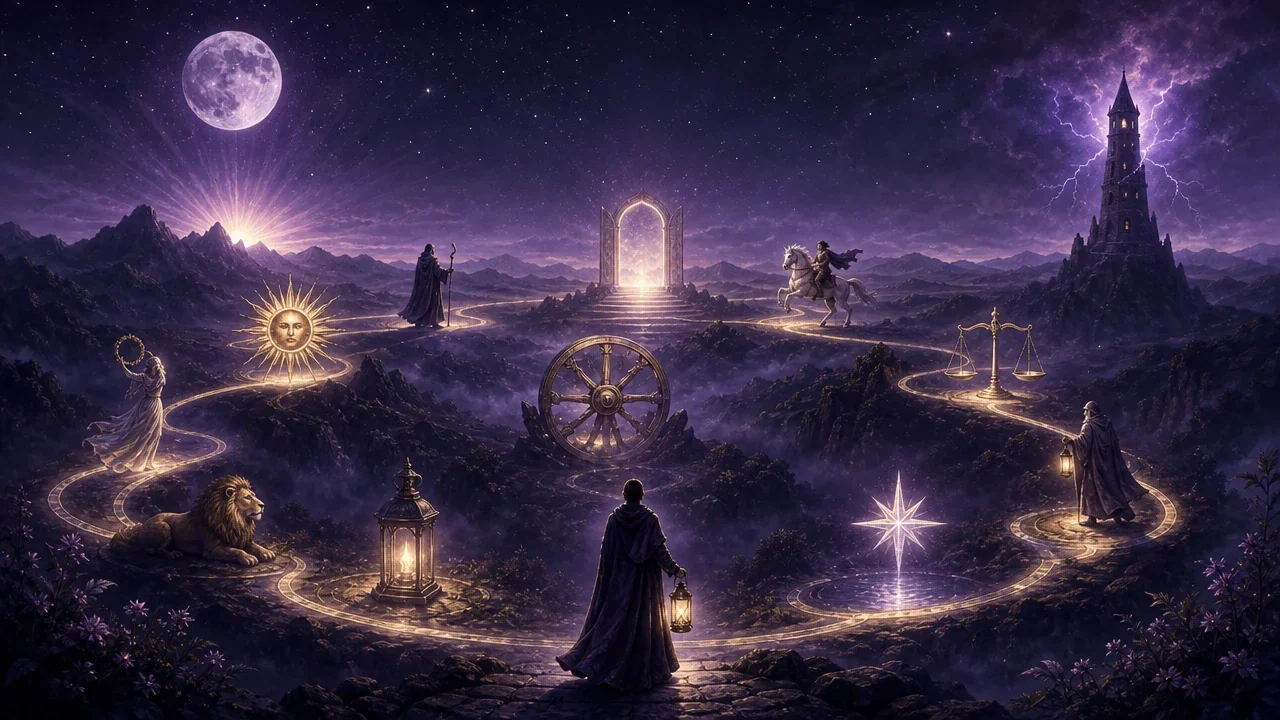
A traditional Tarot deck contains 78 cards divided into two distinct groups: 22 Major Arcana and 56 Minor Arcana. While the Minor Arcana often addresses everyday situations and specific dynamics, the Major Arcana carries the deck's most profound symbolic weight. These 22 cards represent archetypal themes, significant transitions, meaningful choices, and the kinds of experiences that shape a life over time.
The Major Arcana begins with The Fool, a figure poised at the edge of possibility, and ends with The World, a card suggesting completion and integration. This sequence can be approached as a progression through human experience, sometimes called the Fool's Journey in modern Tarot teaching. That framework is not an ancient doctrine, but rather a contemporary interpretive tool that helps readers understand how the cards might relate to one another as chapters in a larger narrative.
Understanding the Major Arcana requires recognizing that no card carries one fixed meaning. Each symbol opens possibilities that shift according to the question being considered, the position the card occupies, and the other cards surrounding it. A coherent reading emerges from the relationships between cards rather than from isolated definitions applied mechanically.
The Structure of the Major Arcana
In many modern decks, the Major Arcana is presented as a sequence from The Fool, marked as 0, through The World at 21. In other traditions, The Fool remains unnumbered. This sequence reflects a movement through experience rather than a strict chronological path. The Fool, unnumbered or marked as zero, represents openness, spontaneity, and the willingness to step into the unknown. The journey continues through encounters with agency, intuition, authority, tradition, and choice before moving into challenges, reflection, and ultimately integration.
Numbering varies by tradition. Tarot de Marseille commonly places Justice at 8 and Strength at 11, while Rider-Waite-Smith places Strength at 8 and Justice at 11. TarotReveal follows the latter sequence.
The Major and Minor Arcana are often distinguished by emphasis rather than importance. The Minor Arcana commonly brings attention to everyday circumstances, practical choices, relationships, and developing situations, while the Major Arcana tends to foreground broader archetypal patterns and significant transitions. These are not necessarily rare or dramatic events, but experiences that may carry lasting meaning.
The Cards and Their Core Symbolic Possibilities
Each Major Arcana card offers a central symbolic theme that can be explored in many directions. The Fool represents beginnings, risk, openness, and the possibility of stepping forward without certainty. The Magician suggests agency, skill, intention, and the ability to direct energy toward a purpose. The High Priestess carries themes of intuition, patience, hidden knowledge, and inward awareness.
The Empress speaks to creativity, nurture, abundance, and connection. The Emperor introduces structure, authority, boundaries, and the responsibility that comes with stability. The Hierophant addresses tradition, teaching, shared beliefs, and the guidance offered by established systems. The Lovers concerns relationships, values, alignment, and meaningful choices that shape direction.
The Chariot reflects determination, discipline, movement, and the will to move forward with purpose. Strength explores courage, restraint, patience, and the kind of power that comes from inner steadiness rather than force. The Hermit suggests solitude, reflection, wisdom, and the distance necessary for deeper understanding. Wheel of Fortune introduces cycles, change, timing, and the recognition that circumstances shift.
Justice addresses accountability, balance, clarity, fairness, and the consequences that follow actions. The Hanged Man reflects pause, surrender, suspension, and the altered perspective that comes from waiting. Death represents endings, transition, release, and transformation. It is not a prediction of physical death, but rather the symbolic conclusion of one phase and the threshold of another.
Temperance suggests moderation, patience, integration, and the careful adjustment required to bring disparate elements into balance. The Devil addresses attachment, compulsion, restriction, and the patterns that require honest examination. The Tower indicates disruption, revelation, instability, and the collapse of structures that can no longer hold. It is not a guaranteed catastrophe, but rather the symbolic breakdown that often precedes rebuilding.
The Star offers hope, renewal, openness, and trust after difficulty. The Moon explores uncertainty, imagination, fear, intuition, and the realm of incomplete understanding. The Sun brings clarity, vitality, confidence, warmth, and joy. Judgement reflects reckoning, awakening, responsibility, and the ability to respond to what has been learned. The World suggests completion, integration, fulfillment, perspective, and the movement into another cycle.
How Context Shapes Meaning
A Major Arcana card does not carry the same message in every reading. Its meaning shifts according to the question being explored, the position it occupies within a spread, and the cards that appear around it. The same card may reinforce a narrative, complicate it, or redirect it entirely depending on these relationships.
Consider The Hermit. In a position representing the current situation, this card might describe present withdrawal, a period of reflection, or the need to step back from external demands. In a position representing the outcome or likely direction, The Hermit may suggest that greater solitude, contemplation, or distance is becoming necessary. In a position exploring potential, it might indicate that wisdom will emerge through introspection rather than action.
The emotional and practical context of the reading also matters. The Tower appearing in a reading about a strained relationship may suggest that unspoken tensions are reaching a breaking point, while the same card in a career reading might describe the collapse of an unsustainable work structure. The symbol remains consistent, but its application changes.
This interpretive flexibility is not a flaw in the system. It reflects the way symbolic language works. The Major Arcana provides a vocabulary for discussing complex inner and outer experiences, and like any vocabulary, its usefulness depends on how thoughtfully it is applied.
Reading Difficult Cards Without Fear
Several Major Arcana cards carry imagery or names that can appear alarming at first glance. Death, The Devil, and The Tower are often met with apprehension, particularly by those new to Tarot. These cards should not be interpreted as literal disasters or unavoidable catastrophes. Their symbolic possibilities are more nuanced and often more useful than their dramatic appearances suggest.
Death does not predict physical death. It represents endings, transitions, the release of what no longer serves, and the transformation that follows. A relationship may end, a belief may dissolve, a phase of life may close. The card addresses the inevitability of change and the necessity of letting go.
The Devil reflects attachment, compulsion, restriction, and the patterns that bind us, often with our own participation. It may describe an unhealthy dynamic, a self-sabotaging habit, or the temptation to remain in a situation because leaving requires confronting discomfort. The card invites examination rather than despair.
The Tower suggests disruption, revelation, and the collapse of structures that have become unstable. It may describe a sudden change, an uncomfortable truth coming to light, or the dissolution of something built on an unsound foundation. While the imagery is dramatic, the card often points toward necessary rather than gratuitous upheaval.
These cards ask difficult questions. They do not deliver punishments or confirmations of doom. Interpreting them requires honesty, context, and the recognition that symbolic disruption often precedes meaningful growth.
How TarotReveal Uses the Major Arcana
TarotReveal's interactive readings use the 22 Major Arcana within a four-card structure designed to create a coherent narrative. The four positions represent the current situation, how the situation is already formed, potential and possibilities, and the likely outcome or direction. This framework allows each card to contribute a distinct layer of meaning while remaining connected to the whole.
The fixed Tarot interpretations used on the platform were written by an experienced professional Tarot reader. They are not generated on demand for individual readings. Readers select four cards and consider how each professionally written interpretation relates to its position and the complete spread. The outcome position represents a likely direction suggested by the spread, not a guaranteed prediction or unavoidable future.
This approach emphasizes interpretation over automation. The Major Arcana provides the symbolic material, the positions provide structure, and the reader brings context and personal insight to the process. The result is a reading that invites reflection rather than delivering fixed answers.
Building a Coherent Reading from Multiple Cards
A single Major Arcana card offers possibilities. A combination of cards creates a conversation. The relationships between cards matter as much as the individual symbols. A reading should form a narrative that feels coherent, even when it introduces complexity or contradiction.
Imagine a four-card reading in which The Magician appears in the current situation, The Hermit in how the situation is formed, The Lovers in potential, and The World in the outcome. The Magician suggests present agency and intention. The Hermit may indicate that this agency developed through withdrawal or reflection. The Lovers points toward a meaningful choice or relationship as a developing possibility. The World suggests that integration and completion are the likely direction. The sequence might be read this way: reflection supports clarity, clarity enables choice, and choice may move toward integration.
Not every reading will feel this tidy. Sometimes the cards seem to contradict one another. The Sun in potential and The Moon in outcome creates tension. Does clarity give way to confusion? Does joy become complicated by uncertainty? These apparent contradictions often reflect the actual complexity of a situation. A reading does not have to resolve every question to be useful.
The practice of reading the Major Arcana is the practice of holding multiple symbolic possibilities in mind and finding the thread that connects them to lived experience. It requires patience, honesty, and the willingness to sit with ambiguity.
The Major Arcana as a Symbolic Vocabulary
The 22 Major Arcana cards are not a system that determines the future. They are a symbolic vocabulary for reflecting on experience, recognizing patterns, and considering possibilities. Their power lies in their capacity to articulate what might otherwise remain unnamed: the moment when control must be released, the recognition that a foundation has shifted, the choice between two meaningful paths.
Tarot symbolism can feel meaningful because it gives recognizable patterns in human experience a visual and symbolic language. We encounter authority and resist it. We face loss and eventually integrate it. We build structures that eventually require adjustment or dismantling. The Major Arcana offers language for these recurring themes without reducing them to formulas or fixed outcomes.
Learning the Major Arcana takes time. Familiarity with individual card meanings is only the beginning. Understanding how those meanings shift in context, how they interact with one another, and how they relate to the specific question being explored requires practice and attention. The cards become more useful the more thoughtfully they are approached.
Approached as a reflective tool rather than a source of supernatural certainty, the Major Arcana can illuminate questions, clarify choices, and provide a framework for understanding the experiences that shape a life. They do not promise answers. They offer a way of asking better questions.