
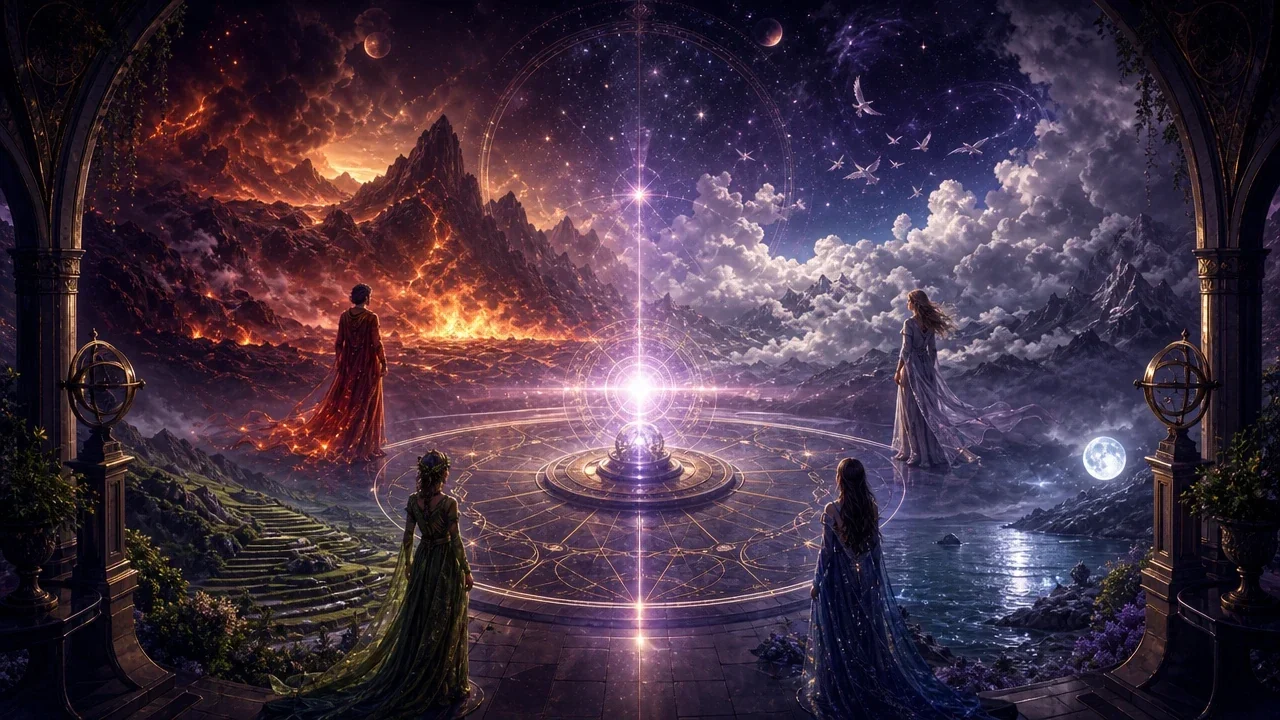
In Western astrology, the twelve zodiac signs are traditionally organized into four elemental families: Fire, Earth, Air, and Water. Each element represents a broad symbolic style of engagement with experience, motivation, and expression. These categories are not scientific measurements or rigid personality types. They are interpretive tools that can help readers notice differences in temperament, communication, and relational rhythm.
The zodiac elements describe recurring patterns rather than fixed destinies. They offer a vocabulary for understanding why some interactions feel immediately familiar while others require conscious translation. Fire signs approach life through action and enthusiasm. Earth signs move through practicality and sustained effort. Air signs engage through ideas and connection. Water signs respond through emotion and intuition.
Each element contains three signs that share fundamental qualities yet express them in distinctly different ways. Understanding the elements can clarify why Aries, Leo, and Sagittarius all radiate vitality yet feel unmistakably different. It can explain why Taurus, Virgo, and Capricorn all value tangible results but pursue them through contrasting approaches. These distinctions become meaningful when modality and individual context are considered alongside elemental symbolism.
What the Four Zodiac Elements Represent
The zodiac elements are symbolic classifications that organize the twelve signs according to shared qualities of perception, motivation, and expression. They represent fundamental orientations toward experience rather than complete descriptions of individual people. Fire is traditionally associated with direct action and vitality. Earth is associated with material reality and stability. Air is associated with communication and ideas. Water is associated with emotion and intuition.
These four categories create a framework for understanding how different signs prioritize different dimensions of experience. Fire signs may emphasize spontaneity and courage. Earth signs may value reliability and tangible outcomes. Air signs may focus on perspective and social connection. Water signs may respond to emotional undercurrents and relational depth.
The elements are distributed evenly across the zodiac. Each element contains one cardinal sign, one fixed sign, and one mutable sign. This combination of element and modality creates the twelve distinct zodiac archetypes. Element describes the core symbolic substance, while modality describes how that substance moves, sustains itself, or adapts. Together, they help explain why signs sharing an element can still feel significantly different.
Fire Signs: Aries, Leo, and Sagittarius
Fire signs are traditionally associated with enthusiasm, initiative, courage, inspiration, and forward momentum. They tend to engage with life directly and expressively. Fire symbolizes warmth, vitality, and the capacity to ignite action. These signs may prioritize authenticity, immediacy, and visible impact. They often radiate confidence and generate energy in their environments.
The strengths commonly associated with Fire include passion, optimism, generosity, and the willingness to take risks. Fire signs may inspire others through their conviction and commitment. They can bring clarity through directness and mobilize movement when circumstances feel stagnant. Their challenges may include impatience, impulsiveness, difficulty slowing down, and a tendency to overlook emotional or practical subtleties in pursuit of immediate goals.
Aries, Leo, and Sagittarius share the symbolic qualities of Fire but express them in distinctly different ways. Aries is cardinal Fire, initiating action with bold immediacy and competitive drive. Leo is fixed Fire, sustaining intensity through creative expression, loyalty, and concentrated personal presence. Sagittarius is mutable Fire, redirecting vitality through exploration, philosophical inquiry, and restless curiosity. All three signs may value courage and authenticity, yet their approaches to leadership, commitment, and self-expression differ considerably.
Earth Signs: Taurus, Virgo, and Capricorn
Earth signs are traditionally associated with practicality, stability, material awareness, patience, and sustained effort. They tend to engage with the tangible dimensions of experience, valuing what can be measured, built, or directly sensed. Earth symbolizes groundedness, reliability, and the capacity to create lasting structures. These signs may prioritize competence, security, and tangible progress.
At its most constructive, Earth contributes dependability, resourcefulness, attention to detail, and the patience to persevere through difficulty. Earth signs may provide steady support during periods of uncertainty. They can translate ideas into concrete results and maintain functional systems over time. Their challenges may include rigidity, excessive caution, resistance to change, and difficulty releasing control when circumstances require flexibility or emotional vulnerability.
Although Taurus, Virgo, and Capricorn belong to the same elemental family, each translates Earth's practical orientation into a different rhythm. Taurus is fixed Earth, stabilizing through sensory appreciation, consistency, and determined attachment to chosen values. Virgo is mutable Earth, adapting through refinement, analysis, and practical responsiveness to immediate needs. Capricorn is cardinal Earth, initiating through ambition, strategic planning, and disciplined effort toward long-term achievement. Their shared concern with competence and tangible results does not make their relationships to pleasure, service, and authority interchangeable.
Air Signs: Gemini, Libra, and Aquarius
Air signs are traditionally associated with communication, ideas, curiosity, perspective, social awareness, and conceptual thinking. They tend to engage with experience through language, observation, and relational exchange. Air symbolizes movement, connection, and the capacity to see multiple viewpoints simultaneously. These signs may prioritize understanding, fairness, and intellectual stimulation.
Air finds some of its clearest strengths in adaptability, objectivity, articulate expression, and the ability to connect different people or perspectives. Air signs may excel at negotiation, collaboration, and generating fresh ideas. They can bring clarity through analysis and facilitate dialogue when positions feel entrenched. Their challenges may include detachment, inconsistency, overthinking, and difficulty remaining emotionally or practically grounded when abstract reasoning becomes disconnected from lived experience.
Within the Air family, Gemini, Libra, and Aquarius direct their curiosity and intelligence toward notably different forms of engagement. Gemini is mutable Air, adapting through conversational agility, information gathering, and intellectual restlessness. Libra is cardinal Air, initiating through aesthetic judgment, diplomatic engagement, and relational balance. Aquarius is fixed Air, sustaining through principled commitment to ideas, innovation, and collective awareness. Their shared interest in communication and perspective still produces very different approaches to intimacy, collaboration, and independence.
Water Signs: Cancer, Scorpio, and Pisces
Water signs are traditionally associated with emotion, intuition, sensitivity, imagination, relational depth, and awareness of subtle undercurrents. They tend to engage with the interior dimensions of experience, responding to feeling, memory, and symbolic resonance. Water symbolizes receptivity, fluidity, and the capacity to merge with emotional or imaginative states. These signs may prioritize intimacy, empathy, and meaningful connection.
Water's constructive qualities include compassion, perceptiveness, creativity, and a capacity to offer meaningful emotional support. Water signs may understand what remains unspoken and respond with genuine care. They can offer comfort through presence and create beauty through imaginative expression. Their challenges may include emotional overwhelm, withdrawal, idealization, and difficulty establishing boundaries when empathy becomes indistinguishable from absorption of others' feelings.
Cancer, Scorpio, and Pisces all work through Water's emotional and intuitive language, but each responds to that language differently. Cancer is cardinal Water, initiating through protective attachment, nurturing care, and responsiveness to family or belonging. Scorpio is fixed Water, sustaining through emotional intensity, investigative depth, and transformative commitment. Pisces is mutable Water, adapting through imaginative receptivity, spiritual sensitivity, and fluid compassion. Their common emphasis on emotional authenticity does not erase important differences in how they approach vulnerability, power, and boundaries.
How Elements Interact in Relationships
The zodiac elements provide one symbolic lens for considering relational dynamics. Signs sharing an element may recognize familiar rhythms in one another. Two Fire signs might experience immediate mutual enthusiasm and shared impatience. Two Earth signs might value similar practical priorities yet struggle with mutual inflexibility. Two Air signs might enjoy intellectual rapport but lack grounding. Two Water signs might understand each other's emotional depth yet risk amplifying shared intensity.
Signs from different elements introduce contrast and potential complementarity. Fire and Air are traditionally considered mutually stimulating. Fire provides vitality and direction; Air offers perspective and communication. This combination can generate momentum and creative exchange, though Fire may occasionally find Air too detached while Air may feel overwhelmed by Fire's intensity. Earth and Water are traditionally considered supportive. Earth provides stability and containment; Water offers emotional depth and intuition. This combination can create safety and nurturing growth, though Earth may sometimes find Water too changeable while Water may experience Earth as emotionally unresponsive.
Fire and Water may combine passion with emotional misunderstanding. Fire's directness can feel insensitive to Water's subtlety, while Water's emotional complexity may frustrate Fire's preference for clarity. Earth and Air may approach experience through different priorities. Earth focuses on tangible results and sensory reality; Air emphasizes ideas and social connection. This pairing can balance abstraction with practicality but may also struggle with fundamentally different communication styles. These patterns are interpretive possibilities rather than fixed outcomes. Every relationship involves individual people with unique histories, values, and capacities for growth.
TarotReveal's Zodiac Compatibility experience compares two Western zodiac Sun signs and presents editorial guidance about characteristic strengths, tensions, and relational rhythms. The compatibility scores and match labels are symbolic summaries. They are not scientific measurements, statistical probabilities, or predictions about whether a real relationship will succeed.
Broader astrological traditions may examine complete birth charts, including Moon signs, Venus, Mars, Ascendants, houses, and planetary aspects. TarotReveal currently focuses on Sun sign symbolism as one accessible starting point for reflection.
Using Elemental Symbolism Thoughtfully
The four zodiac elements offer a symbolic vocabulary for noticing differences in temperament, motivation, and expression. They can help readers recognize their own patterns and understand why certain interactions feel effortless while others require conscious adjustment. Fire may naturally prioritize action over deliberation. Earth may instinctively value security over spontaneity. Air may default to analysis over embodiment. Water may respond first through feeling rather than logic.
Understanding your own elemental tendencies can support self-awareness. If your Sun sign is a Fire sign, you might notice how quickly you move toward new projects and how difficult it can be to sustain interest once initial excitement fades. If your Sun sign is an Earth sign, you might recognize your capacity for patience and your occasional resistance to necessary change. If your Sun sign is an Air sign, you might observe your skill with communication and your tendency to intellectualize emotions. If your Sun sign is a Water sign, you might appreciate your empathy while acknowledging the challenge of maintaining boundaries.
Elemental symbolism becomes limiting when used to reduce people to categories or to make assumptions about compatibility without considering individual complexity. No one expresses every quality associated with their element. Personal history, cultural context, and conscious choice shape how elemental tendencies manifest. A Scorpio may be deeply sensitive yet also fiercely independent. An Aquarius may value intellectual exploration yet also cultivate emotional intimacy. A Capricorn may pursue ambition yet also prioritize relational warmth.
The elements are most useful when held lightly as reflective tools rather than diagnostic certainties. They can broaden perspective, clarify misunderstandings, and suggest areas where conscious effort may support growth. They cannot replace direct communication, lived experience, or the ongoing work of understanding another person.
Relational success depends on mutual respect, shared values, emotional intelligence, and the willingness to navigate difference with curiosity rather than judgment. The zodiac elements offer symbolic insight, but they remain one dimension of a far more complex human story.